

Programmatic advertising moves roughly $725 billion globally in 2026, and now accounts for 91.5% of all digital display ad spend worldwide.
Yet the agencies driving much of the spending don't know how much of it actually goes to ads that convert.
ANA's (Association of National Advertisers) landmark supply chain study found that only about 36 cents of every dollar entering a demand-side platform actually reaches a consumer, with the rest going to ad tech fees, low-quality media, and intermediaries.
Independent agencies, especially not the Dentsus and WPP of the world, have an extra layer of leakage the industry studies don't even model: the rented DSP seat.
If a small/mid-tier agency buys programmatic ads through someone else's seat, typically a reseller, a trading desk, another agency's master account, you're paying the platform's take rate plus the seat owner's markup, before a single ad impression runs.
In this blog, we talk about how an agency can save DSP margin costs with real data and actionable next steps for small and mid-tier agencies. Underneath all of it sits one question: who owns the programmatic advertising platform.
Data in Numbers
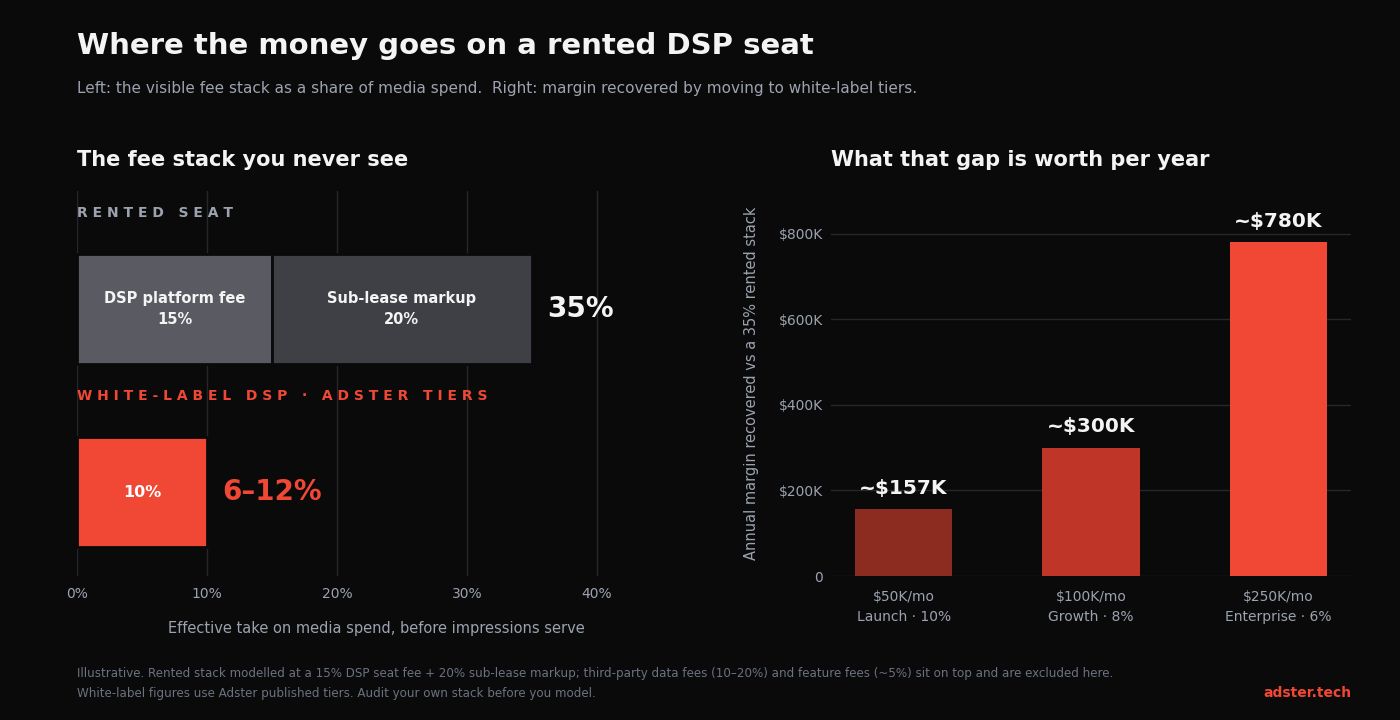
- A rented seat typically costs agencies a 15–20% DSP platform fee with a 10–25% reseller/sub-lease markup. This means, for small and mid-sized agencies, roughly 35% of media spend is gone before ad impressions serve.
- Building a DSP from scratch costs $150K–$1.5M+ upfront and $1.9M–$2.9M per year to run, takes 12–24 months, and is only profitable above ~$50M in annual spend.
- A white-label DSP delivers platform ownership economics including your brand, your margins, your client relationships for a 6–12% platform fee, live in days rather than years.
- This means, on $100K/month of media spend, moving from a 35% rented-seat fee stack to a 10% white-label fee recovers ~$300K per year in margin.
How Agencies Lose Money By Renting DSPs
Enterprise DSPs were built for agency behemoths, and their commercial terms show it through words and actions.
The Trade Desk, the largest independent DSP, doesn't publish a price list.
Still, practitioner and analyst sources consistently report minimum spend commitments of $100,000+ per quarter, with agency accounts often expected to clear $150,000+ per month.
Google's DV360 is similarly geared toward large committed budgets, with account managers only catering to the big accounts.
Mid-tier agencies that can't hit those minimums do the obvious thing: they rent from the bigger agencies.
They buy through a reseller's seat, a managed self-serve arrangement, or another agency's master account. While it solves the access problem, it creates a margin problem, because two parties now take a cut of every dollar spent on programmatic ads.
Here is how this works in practice:
- The DSP's platform fee.
A GroupM audit found programmatic platforms collectively absorb ~20% of ad spend, which is roughly 10% on the demand side and 10% on the sell side.
- The Seat Owner's Markup.
Sub-lease markups are rarely disclosed and commonly run 10–25% of spend, layered on top of the platform fee.
What a Rented DSP Seat Really Costs
The seat fee is only the visible layer. Four more distinct costs also factor against a smaller agency's P&L.
1. The visible fee stack
| Typical range | Who takes it | |
|---|---|---|
| DSP platform fee/take rate | 15–20% of spend | The DSP |
| Sub-lease / reseller markup | 10–25% of spend | The seat owner |
| Third-party data fees | 10–20% of spend | Data providers (often marked up) |
| Feature fees (bid shading, identity, predictive clearing) | ~5% of spend | The DSP |
| Optional managed service | 3–20% of spend | The seat owner/service desk |
Even before markups, an advertiser putting $1M through a major DSP might see only ~$650K reach publishers, with ~$200K to data providers, ~$100K in platform margin, and ~$50K in feature fees.
2. The invisible fees
An AdExchanger investigation revealed the fees buyers never see:
- Discrepancy adjustments that quietly inflate bids (a $1.00 bid billed at $1.03–$1.05),
- Undisclosed data markups ranging from 3% to 300%,
- QPS rebates (Queries per second) extracted from exchanges, and margins on “curated” supply deals.
For a small/mid-sized agency, renting a seat means you inherit all of this with zero ability to audit the log-level data that belongs to the seat owner.
3. The brand tax
Based on our conversations with prospects and customers, we consistently see teams burning ~20 hours per week on manual reporting, reconciliation, and chasing the seat owner for data, thus delaying optimization decisions on live budgets.
And there's the cost that never shows up in a spreadsheet: you have 0% brand ownership.
Your clients log into someone else's platform, see someone else's logo, and learn that the actual capability sits outside your agency.
In a market where clients increasingly demand supply-path transparency, using a partner's seat isn't defensible and is an open invitation for the client to go around you.
Solving for This
Option 1: Building Your Own DSP
- Industry build-vs-buy analyses put custom DSP development at $150K–$1.5M+ upfront, with 12–24 months to a production-grade platform.
- Epom's engineering breakdown estimates a $1.5M–$2.5M/year dev-and-infrastructure baseline plus ~$400K/year in core team overhead, a combined $1.9M–$2.9M every year, requiring 10–13 full-time specialists.
- Listening to the open exchange at scale (millions of queries per second), maintaining exchange integrations, fraud filtering, and compliance are all ongoing costs, not one-time projects.
When It Breaks Even/Makes Sense For You
Analyses generally place the ad spending threshold at $50M+ in annual media spend before a self-built DSP recovers its cost, with break-even at 2-4 years even for well-funded DSP builds.
When Should You Build A DSP?
- You manage $50M+ in annual programmatic spend, have product ambitions beyond media buying (you're becoming an ad tech company), and can hire and retain RTB engineering talent for years.
Don't build if
- You need margin relief this fiscal year, your spend is in the $300K–$30M annual range, or engineering isn't your core business.
Option 2: White-Label DSP
A white-label DSP, on the other hand, has a full-stack platform that contains
- Bidder,
- Exchange integrations,
- Targeting,
- Reporting,
- AI optimization
All deployed under your domain, your logo, and your commercial terms. The key advantage for small and mid-sized agencies is that the technology partner is invisible and your clients only see your product.
What It Costs
Market pricing for white-label DSPs runs $2,000–$50,000/month depending on tier, or a revenue share of roughly 7–12% of media spend, with deployment in days or weeks and typical break-even in 3–6 months (versus 2–4 years for a DSP build). Between them, those two models cover almost all white label DSP pricing.
Adster DSP sits at the aggressive end of that curve: a 10% platform fee at Launch tier, 8% at Growth ($25K–$100K monthly), and 6% at Enterprise (above $100K monthly) with no setup fees, and a 30-day pilot with the platform fee waived.
What You Gain with A White-Labeled DSP
- Margin Control:
You keep the spread between the platform fee and whatever rate you set for clients. You're now the one holding the DSP seat, not some big-shot agency.
- Brand Ownership:
Branded login, dashboards, reports, and alerts. In the client's eyes, they only see your brand in control.
- Transparency You Can Show Clients:
Direct ad supply access (Google Authorized Buyers, OpenRTB exchanges, PMP deals) instead of a sub-account inside someone else's stack; If you want to show log-level data for more credibility, it is your call. In practice, that is what makes it a DSP with log-level data access.
- Data Ownership:
Your campaign and log data, your first-party audience matches, your reporting cadence.
What to Diligence Before Going For a White-labeled DSP
You still don't own the underlying IP, so vet the vendor infrastructure: supply integrations and ads.txt verification, uptime SLAs, data protection compliance (GDPR in Europe and DPDP if you operate in India), security track record, and whether the DSP fee schedule is flat and published rather than a new black box.
When to Go For White-Label
If you're an agency or media company with roughly $10K–$500K/month in programmatic spend, you want platform economics without platform engineering, and owning the client relationship matters to your growth story. For most independent shops, that is the profile of the best DSP for small agencies.
Build vs. Rent vs. White-Label: The Full Comparison
| Dimension | Rent a seat (direct/sub-leased) | White-label DSP | Build your own |
|---|---|---|---|
| Upfront cost | $0 | $0 (Adster) to ~$20K onboarding (market) | $150K–$1.5M+ |
| Time to launch | Days–weeks | 24 hours (Adster) to 8 weeks (market) | 12–24 months |
| Ongoing cost | 15–20% platform fee + 10–25% markup + data/feature fees | 6–12% platform fee | $1.9M–$2.9M/year baseline |
| Effective take on media | ~35% in a typical rented stack | 6–12% | Infrastructure cost only |
| Brand ownership | 0% | 100% (your domain, logo, theme) | 100% |
| Data & log-level access | Owned by seat holder | Full | Full |
| Supply-path transparency | Opaque; inherited markups | Direct exchange/PMP access | Full |
| Client margin control | None; margins set by fee stack | You set per-client margins | Full |
| Team required | Trading team only | Trading team only | 10–13 FTE engineering + ops |
| Break-even | Never; costs scale with spend | 3–6 months | 2–4 years (needs $50M+/yr spend) |
| Best for | <$25K/month, occasional programmatic | $10K–$500K+/month agency spend | $50M+/yr spend, ad tech ambitions |
The Margin Math on Real Numbers
Take an agency running $100K/month in programmatic media:
- Rented seat (typical 35% stack): $35,000/month lost to the seat fee and markup: $420K/year off the top.
- White-label at a 10% platform fee: $10,000/month, leaving $25,000/month, or $300K/year, back in the agency's margin on identical spend.
Scale the same math across Adster's published tiers and the annual recovery looks like this:
| Monthly media spend | Tier | Annual margin recovered vs. 35% rented stack |
|---|---|---|
| $50K/month | Launch (10%) | ~$157K/year |
| $100K/month | Growth (8%) | ~$300K/year |
| $250K/month | Enterprise (6%) | ~$780K/year |
Figures are illustrative, based on a 15% DSP seat fee + 20% sub-lease markup versus Adster's published tier fees; your current stack may be higher or lower; audit it before you model.
And that's only the money.
It ignores the ~20 hours a week of reconciliation labor, the data fees you can now negotiate directly, and the pricing power that comes from selling a branded platform instead of reselling someone else's.
Why Branded DSPs Are Increasingly Chosen By Agencies
1. Transparency is now a client-side mandate.
Clients are increasingly scrutinizing their ad spend and demanding log-level data, with RFPs specifically asking for it.
Agencies that can't show their ad supply path will keep losing pitches to agencies that can.
2. AI has automated the execution layer.
Bidding, pacing, and optimization are machine-driven now.
Manual trading skill - the thing a rented seat lets you sell is no longer the differentiator. Owning the platform, the data, and the client relationship is.
3. The Economics of DSP is Trending Down
Amazon's low-fee DSP is forcing incumbents to negotiate for the first time in years, but the concessions flow to buyers clearing $500K+ spend thresholds.
Advertisers are consolidating DSP relationships (down 40% in two years). Mid-tier agencies are being squeezed from both ends - enterprise minimums above them, fee-pressured clients below them.
White-labeling closes that gap without the capital cost of building a separate DSP.
A Simple Decision Framework For Agencies
- What's my true effective fee stack?
Add platform fee + markup + data fees + service fees.
- What's my monthly programmatic spend trajectory?
- Under $25K/month: renting or a launch-tier white-label both work.
- $25K–$500K/month: white-label economics dominate.
- $50M+/year with product ambitions: model a build.
- Who owns the client experience?
If losing your seat access tomorrow would take your programmatic offering to zero, it is time to get rid of the dependency.
- What would 6–12% total platform cost do to my P&L versus today's stack?
If the price of continuing to rent is more than the platform cost, it is time to shift.
Where Adster DSP Fits
Adster DSP is a full-stack, white-label demand-side platform built for small and mid-sized agencies who want transparency.
Agencies using Adster get their own branded DSP (custom domain and SSL, their logo and theme, branded logins, reports, and alerts) with Adster completely invisible to their clients. It runs as a self serve DSP with no minimum spend.
Under the hood, we provide:
- Direct supply access (Google Authorized Buyers, OpenRTB exchanges, PMP deals, and an ads.txt-verified publisher SDK),
- AI-driven bidding and campaign co-pilot,
- Full targeting and audience tooling,
- Real-time unified reporting, and
- Multi-tenant sub-account management for client organizations, each with its own margin setting you control.
The platform is GDPR- and DPDP-compliant, has run for two years with zero security breaches and 99.9% uptime, and its optimization engine is backed by a USPTO patent (12,307,480 B1).
What We Charge?
10% / 8% / 6% platform fee tiers, no setup or onboarding fees, a 30-day pilot with the platform fee waived, and a branded deployment live within 24 hours.
More than 42 agencies across India, the US, Singapore, the UK, the Middle East, and Europe run on Adster today, with 1,000+ campaigns executed, 50%+ average margin uplift, and $28M+ in additional agency revenue enabled.
If you want to see the math against your own fee stack, book a 30-minute technical walkthrough, or write to [email protected].Talk to us today.
FAQs
1. What is a DSP seat fee?
A DSP seat fee is the platform charge for accessing a demand-side platform, typically 15–20% of media spend on major DSPs.
When access comes through a reseller or a bigger agency's seat (“sub-leasing”), their 10–25% markup stacks on top, which is how rented access commonly reaches ~35% of spend.
2. How much does it cost to build a DSP from scratch?
Estimates run $150K–$1.5M+ in upfront development over 12–24 months, plus $1.9M–$2.9M per year in engineering, infrastructure, and team baseline.
Most analyses conclude a self-built DSP only pays back above ~$50M in annual media spend.
3. What is a white-label DSP?
A white-label DSP is a fully built demand-side platform that a technology partner deploys under your brand (your domain, logo, and pricing) so you operate it as your own product. Market pricing runs $2K–$50K/month or 7–12% of spend; Adster's tiers run 6–10% with no setup fee.
4. Is a white-label DSP worth it for a small agency?
Usually yes, once programmatic spend passes roughly $10K–$25K/month. Below that, a rented seat's simplicity might work.
Above the spending threshold, the fee delta (often 20+ points of spend) funds the switch many times over, and break-even typically lands within 3–6 months.
5. How do agencies make money with a white-label DSP?
Three ways:
- The spread between the platform fee (6–12%) and the rate they charge clients,
- Elimination of reseller markups they currently pay, and
- New revenue from productizing the platform by offering self-serve seats to clients and smaller agencies under their own brand.
6. How fast can an agency launch its own branded DSP?
It usually takes two to eight weeks for agencies to launch a new white-labeled DSP.
Adster provisions a branded platform (domain, SSL, logo, theme, and admin credentials) within 24 hours, with a structured 30-day pilot to first campaigns.
Blog Sources
- ANA: First Look: Programmatic Media Supply Chain Transparency Study (waste, MFA, and domain findings)
- ANA: Programmatic Media Supply Chain Transparency Study, Complete Report, December 2023 (PDF)
- Fiducia: Only One-Third of Every Programmatic Dollar Reaches End-User, ANA Report Finds (36-cent working-media figure)
- PPA: ISBA Study Reveals Publishers Miss Out on Half of Adspend (2020 ISBA/PwC study: 51% publisher share, 15% unknown delta)
- ISBA/PwC: Programmatic Supply Chain Study II, Summary, January 2023 (PDF)
- Marketing Week: Second Programmatic Supply Chain Study Reveals ‘Big Step Forward’ in Transparency (65% publisher share, 3% unknown delta)
- Media Planning Tool: The Trade Desk Pricing 2026: Take Rates, Platform Fees & Real Costs (20.3% take rate, minimums, data and feature fees)
- EMARKETER: The Trade Desk Loosens Fees as Amazon DSP Pressure Intensifies
- EMARKETER: How Programmatic Platforms Absorb 20% of Media Ad Spend (GroupM audit)
- EMARKETER: Advertisers Cut Their DSPs 40% Over Two Years
- AdExchanger: Investigation: DSPs Charge Hidden Fees, And Many Can't Afford To Stop
- Epom: How to Build Your Own DSP and Is It Even Worth It? (build cost, team, and break-even estimates)
- Epom: 7 Trade Desk Alternatives That Don't Require a $300K Minimum Spend
- BidsCube: White Label DSP Cost: Pricing Models and What Affects Them (white-label pricing and build-vs-buy figures)
- SearchLab: Programmatic Advertising Statistics 2026 (market size and programmatic display share, per eMarketer)
- Adster DSP platform deck, 2026, internal platform data: illustrative 35% rented-seat fee stack, tier pricing (10%/8%/6%), savings-at-scale scenarios, 42+ live agencies, 1,000+ campaigns, 99.9% uptime, 50%+ average margin uplift, $28M+ additional revenue enabled, USPTO patent 12,307,480 B1.
- Adster's Proprietary Information.