

Most SDK comparisons are vibes. A logo grid, a few bullet points, a soft ranking that avoids saying anything hard.
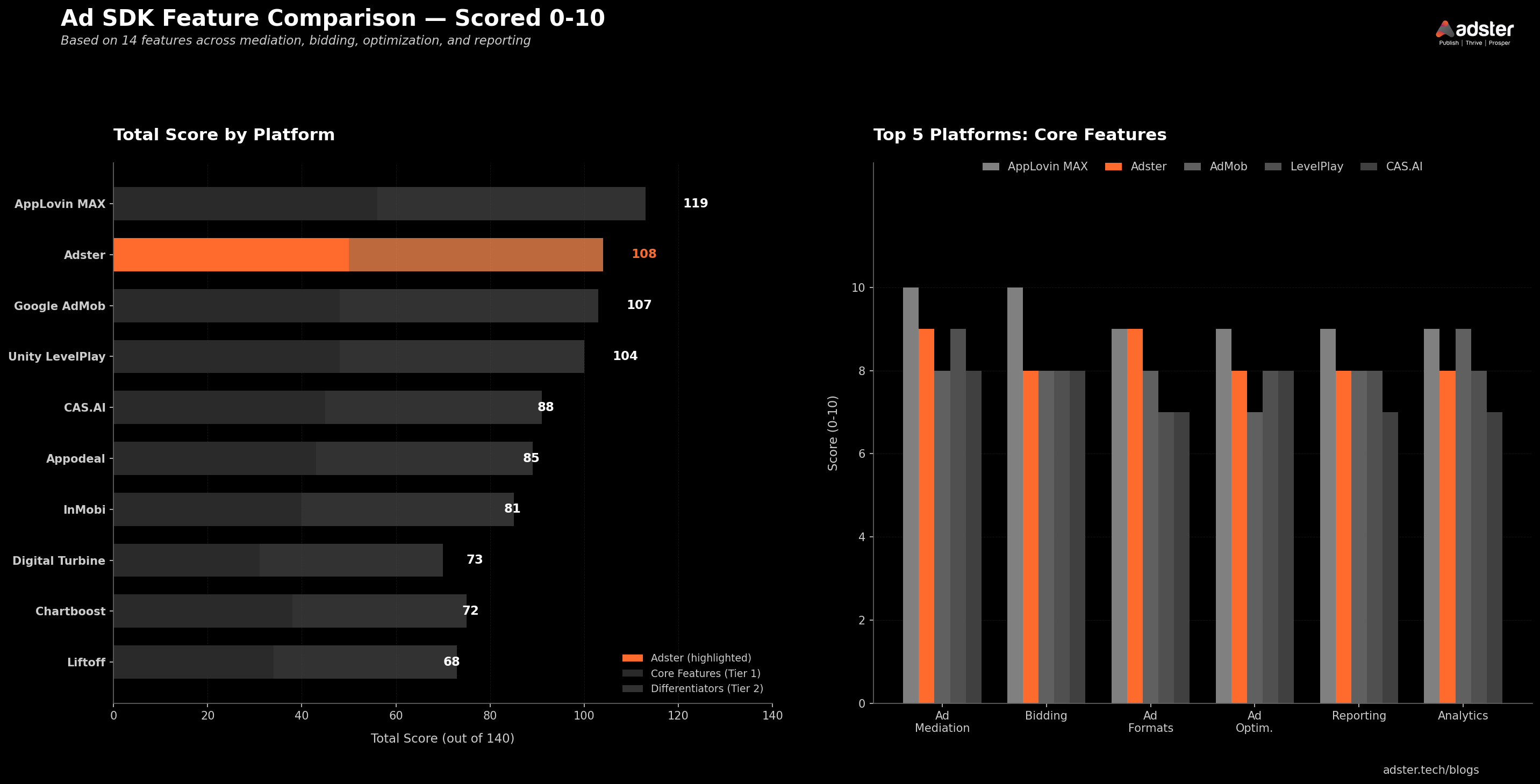
We did the opposite. We took 10 ad SDKs, scored them on 14 features using public documentation, and added the numbers up. Six of those features are what we call core: Ad Mediation, Bidding, Ad Formats, Ad Optimization, Reporting and Dashboards, and Performance Analytics. These are the features that decide your revenue ceiling.
Here is how they stack up, what each one is good at, and where each one falls short.
At a glance
| Rank | Platform | Total / 140 | Core / 60 | Type |
|---|---|---|---|---|
| 1 | AppLovin MAX | 119 | 56 | Mediation Platform |
| 2 | ★Adster | 108 | 50 | Meta Mediation |
| 3 | Google AdMob | 107 | 48 | Mediation + Network |
| 4 | Unity LevelPlay | 104 | 48 | Mediation Platform |
| 5 | CAS.AI | 88 | 45 | Mediation Platform |
| 6 | Appodeal | 85 | 43 | Mediation Platform |
| 7 | InMobi | 81 | 40 | Network + Mediation |
| 8 | Digital Turbine | 73 | 31 | Ad Network SDK |
| 9 | Chartboost | 72 | 38 | Mediation + Network |
| 10 | Liftoff | 68 | 34 | Ad Network SDK |
1.AppLovin MAX119 / 140
The highest total in the comparison. AppLovin MAX scored 10/10 on both Ad Mediation and Bidding, and 9/10 on Ad Formats, Ad Optimization, Reporting, and Analytics.
It earned those scores. MAX runs a unified real-time auction across 60+ ad networks, with 25+ SDK bidders plugged in. The dashboard gives network-level breakdowns. The waterfall-to-bidding migration is essentially done, which means less manual tuning for publishers.
Where it loses points: complexity. MAX is not the SDK to pick if you want something simple. Onboarding takes real work. And the platform has its own demand sitting in the same auction as third-party networks, which is fine, but it is not neutral. Adjust expectations accordingly.
2.Adster108 / 140
Adster scored second overall. It earned 9/10 on Ad Mediation, Ad Formats, and Automated Tools, and 8/10 across most of the other core features.
The reason it scores well is architectural. Adster is a meta mediation layer. It sits on top of your existing setup rather than replacing it. That means publishers can experiment, test demand sources, and adjust configurations without engineering tickets. The platform delivers ads in under 100ms through a global CDN, compared to the 300-500ms industry average. It supports every standard IAB format plus playable ads and AR/VR.
Where it loses points: it is newer. The track record is shorter than MAX or AdMob. If your scale demands multi-year proof points from your vendor, that is a reasonable hesitation.
3.Google AdMob107 / 140
AdMob earned 9/10 on Performance Analytics and 9/10 on Fraud Prevention. Those are real strengths. Firebase integration is genuinely strong, and Google's invalid traffic detection is among the best in the industry.
AdMob scored 8/10 on Ad Mediation and Bidding. It supports 30+ networks through adapters and 70+ through custom events. Integration is the fastest in the category. This is where most publishers start.
Where it loses points: neutrality. AdMob's mediation tends to favor Google demand in the auction. Transparency is weaker than independent platforms. You are operating inside Google's ecosystem, which is fine until you want to optimize outside of it.
4.Unity LevelPlay104 / 140
LevelPlay scored 9/10 on Ad Mediation and 9/10 on A/B Testing, the highest A/B Testing score in the comparison. Its placement optimization tools are genuinely best in class for gaming.
Unity LevelPlay is a mediation platform built for games. Drag-and-drop integration for Unity projects. Strong rewarded video and interstitial performance. 25+ ad networks. Waterfall-only support for Unity Ads ended in January 2026, so bidding is now the standard path.
Where it loses points: non-gaming apps. If your app is not a game, LevelPlay is not the optimal choice. The ecosystem lock-in is real.
5.CAS.AI88 / 140
CAS.AI scored 9/10 on AI Algorithms and 9/10 on Automated Tools. Both are the highest scores in the comparison for those features.
The platform processes 1 million+ requests per second and combines RTB with waterfall backup. Its pitch is automation: you ship one SDK and the AI handles waterfall configuration, floor pricing, and auction logic. It supports 25+ mediation adapters.
Where it loses points: transparency. The AI is a black box. You trust that it optimizes correctly because the numbers eventually show up. That works until they do not, and then you have limited visibility into why.
6.Appodeal85 / 140
Appodeal scored 8/10 on Ad Mediation and 8/10 on Automated Tools. It runs auctions across 70+ demand sources with built-in A/B testing, user segmentation, cross-promotion, and direct deals.
The main draw is packaging. One SDK, no-code optimization, a lite version available for publishers who only want mediation without the UA tools. It is the simplest option for indie developers.
Where it loses points: control. Appodeal makes most decisions for you. That is the point, but it also means advanced publishers run out of levers quickly.
7.InMobi81 / 140
InMobi scored 8/10 on Cross-Platform Support and 7/10 on most core features. Its demand strength is in India, Southeast Asia, and other high-growth markets. If your app has real traffic from those regions, InMobi fills gaps that US-centric networks miss.
The SDK supports banners, interstitials, native, rewarded video, and playables. It integrates with IAS, DoubleVerify, and Moat for viewability and fraud measurement, which adds measurement credibility.
Where it loses points: geography. Outside of APAC and specific emerging markets, the demand thins out fast.
8.Digital Turbine (DT Exchange)73 / 140
DT Exchange scored 3/10 on Ad Mediation. That is not a knock on the product. It is what it is. DT Exchange is a demand source, not a mediation platform.
The SDK plugs into MAX, LevelPlay, and other mediators, connecting publishers to 180+ global demand sources through programmatic channels. It is lightweight, supports server-side ad quality controls, and is GPP-compliant for privacy.
Where it loses points: scope. If you are looking for mediation, this is the wrong tool. If you are looking for programmatic demand to add to your existing stack, it delivers.
9.Chartboost72 / 140
Chartboost scored 8/10 on Bidding and 7/10 on Ad Mediation. Under Take-Two Interactive via Zynga, it has pivoted to a full mediation stack powered by bidding. The SDK is under 340KB, which is remarkable for a mediation platform.
The platform claims zero demand fees for bidding partners, meaning the winning bid equals publisher earnings. Ad queueing (SDK 4.9.0+) lets you show fullscreen ads back-to-back with minimal latency.
Where it loses points: focus. Chartboost is built for gaming interstitials and rewarded ads. Outside gaming, the demand gets thin and the optimization tools feel less relevant.
10.Liftoff (Vungle + Liftoff)68 / 140
Liftoff scored 7/10 on Bidding and 7/10 on Ad Formats. The Vungle merger created a platform that is strong in video and playable formats. Liftoff Monetize supports banner, interstitial, rewarded, rewarded interstitial, native, and app open formats through bidding and waterfall.
Creative optimization tools are a real differentiator. Publishers running heavy video inventory get value from automated creative testing.
Where it loses points: it is a demand source, not a mediator. Like DT Exchange, Liftoff scores best when plugged into MAX or LevelPlay, not when run standalone.
The Shape of the Rankings
Look at the total scores. The top four are clustered between 104 and 119. Then a gap. Then CAS.AI, Appodeal, and InMobi between 81 and 88. Then the bottom three under 75.
That split is not random. The top four are platforms that treat mediation as a product. The bottom three are demand sources or vertical networks that score high on their own specialty and low on mediation because mediation is not their primary job.
Publishers who build monetization stacks typically pick one from each group. A strong mediation platform from the top. A couple of specialized demand sources from further down. The ranking is a map of how to layer them, not a contest you pick one winner from.
Methodology
Scores are based on public documentation, developer resources, and platform websites as of April 2026. 9-10 means best-in-class. 7-8 means strong. 5-6 means adequate. Below 5 means meaningful gaps. Core features are weighted equally for the total score.